
Careers Training – Gen Z
Gen Z’s most aspirational employers revealed
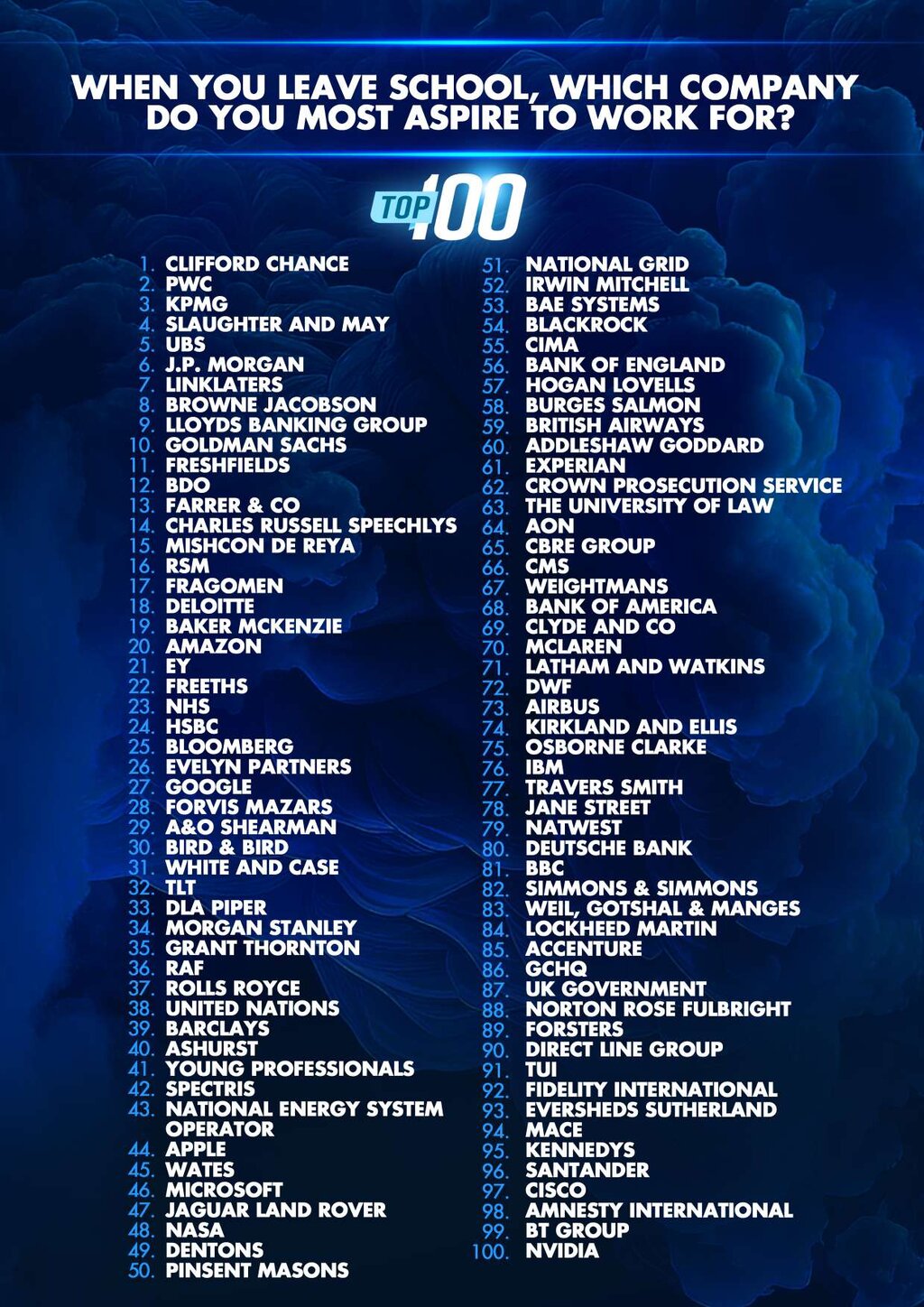
The organisations Gen Z most aspire to work for after leaving school have been revealed in a new survey launched to mark National Apprenticeship Week. The findings offer useful insight into the future talent pipeline for the profession, particularly as firms expand apprenticeship and school-leaver pathways to attract the next generation of accountants and advisers. Dan Miller, founder, Young Professionals UK and currently appearing on BBC One’s The Apprentice summarises the report.
Based on insights from more than 50,000 students, the ranking offers a powerful snapshot of the employers shaping Gen Z ambition at the earliest stage of career decision-making, when young people are weighing up options including apprenticeships, school leaver programmes and further study.
The Young Professionals Top 100 2026 reveals that Magic Circle law firm Clifford Chance is the number one employer young people most aspire to work for, followed by Big Four firms PwC and KPMG in second and third place.
The rankings indicate that young people continue to value employers associated with structured training, clear pathways and strong reputations for progression.
The results point to several interesting shifts. Notably, a law firm ranks first ahead of the usual early-careers powerhouses in professional services, indicating that legal careers are increasingly perceived as accessible and aspirational via structured entry routes.
The presence of Browne Jacobson in the top ten is also significant, with the firm ranking ahead of several larger international brands underlining the impact of employer visibility and early careers engagement.

Lord Phillip Hammond at an event
Meanwhile, the NHS ranks outside the top 20, despite its size and national importance, which may reflect young people’s perceptions of pay, pressure and long-term progression compared with private sector pathways. The Royal Air Force also ranks above Rolls-Royce, while major consumer technology brands such as Apple, Microsoft and Nvidia appear lower down the list than might be expected from young people, suggesting they may prioritise employers with clear UK school leaver programmes and entry routes over global ‘dream brands’.
National Apprenticeship Week is about celebrating the opportunities available to young people and shining a light on the employers creating real pathways into successful careers.
The YP Top 100 2026 shows that Gen Z are ambitious, informed and thinking carefully about their futures. They want to work for organisations that offer structured training, long-term progression and the chance to build meaningful careers straight after school.
Apprenticeships are a vital part of that journey, helping young people earn, learn and gain real-world experience while developing skills that employers need.
Lord Phillip Hammond at an event
The survey also includes sector breakdowns from Young Professionals, highlighting the organisations young people most aspire to work for across law, banking and finance, professional services, and STEM.
In law, the leading firms include Clifford Chance, Slaughter and May, Linklaters, Browne Jacobson and Freshfields. In banking, finance and fintech, the top-ranked organisations include UBS, J.P. Morgan, Lloyds Banking Group, Goldman Sachs and HSBC.
In accounting and professional services, the most aspirational employers include PwC, KPMG, BDO, Deloitte and RSM. In STEM, young people identify Amazon, Google, the Royal Air Force, Rolls-Royce and Spectris as the organisations they most want to work for.
Young Professionals UK has grown into one of the largest school leaver networks in the country, with more than 600,000 young people accessing its services. The organisation helps connect students with alternative pathways into careers, enabling young people to engage directly with employers through industry events, work experience opportunities and apprenticeships.
The company works with around 70 major employers and partners with 4,000 schools across the UK and Ireland.
More than 20,000 students attended Young Professionals events during the October half-term alone, according to the organisation. Last year, it hosted its largest ever event, welcoming more than 3,000 students to The O2 in London.
The sold-out event featured panel discussions with leaders from the Royal Air Force, the University of Law, Grant Thornton and Freshfields, alongside networking opportunities with 20 major recruiters.
Robert Whiteside, CEO, EmpowerRD
Frequent and unexpected changes to the tax rules make long-term planning difficult, and to me that appears particularly so for larger employers.
Sectors impacted by this include retail, hospitality, and healthcare, all of which are very exposed to increases in wage pressure. Into 2026, the companies I work with want certainty regarding their wage bill, and more generally for the tax landscape to settle down now that the ructions of 2025 are behind us.
In short, predictability in employment costs will help firms manage workforce planning while supporting fairer outcomes for employees.
Another priority is certainty around incentives for investment and skills.
Businesses want reassurance that reliefs such as research and development tax credits will remain available for genuine ground-breaking work.
HMRC has recently stamped down hard on what they see as rogue advisers and weak claims, but the net has been cast wide and has caught many genuine research-intensive businesses.
Anecdotally, I am hearing that directors are becoming reticent about putting such claims together because of the fear of HMRC audit.
This is not a healthy environment in which to do business, and it runs counter to the stated intention of the policy to encourage genuine high-quality research.
In addition to a stable tax landscape, businesses want to see wider economic stability at the core of government policy as we move into the new year. Inflation remains a concern, especially wage pressures given the issues I just mentioned. This must be kept under control if businesses are to continue to deliver the growth in job creation that the economy needs. Any changes that are required should be carefully phased in and clearly communicated by the government, rather than the haphazard nature of recent announcements.
Ultimately, what businesses want heading into 2026 is confidence in the rules of the game. Stability in economic and tax policy will provide a foundation for investment and job creation, and that should benefit us all.
The "Strategic Pivot" Precedent
A defining trend from the 2025 season was the rise of the "displaced vote." In several high-profile instances, boards opted to fundamentally reset their long-term strategies without offering shareholders a standalone vote on the new direction. Investors responded by turning the re-election of board chairs into the vote they were not otherwise provided. Significant rebellions, often exceeding 2% of shareholders, became a "lightning rod" for dissatisfaction. This established a clear precedent for 2026: when a board bypasses a direct vote on a major strategic shift, the fallout will land on the individuals standing for election.
Main image: Dan Miller, founder, Young Professionals UK. Main video supplied by kontekbrothers/Creatas Video Plus via Getty Images