

C-Suite: ERP
Alex Curran emphasises externally focused vision for scalable finance ERP
Zoya Malik, editor-in-chief, International Accounting Bulletin speaks to Alex Curran, CEO, Aptitude Software about the experiences, instincts and market insight that shaped the journey to the CEO’s office, her vision for finance-ERP technology investment and why, in an increasingly AI driven world, human judgement and experience remain more powerful than data alone.
Phil Verity, Member of the Global Network Board and former CEO of Forvis Mazars in the UK, was the winner of the IAFA 2025 Personality of the Year award. He has been an instrumental leader in Forvis and Mazars joining forces, an unprecedented move that created one of the most impressive global networks the accounting profession has seen in decades.
Zoya Malik (ZM): How AI-ready do you believe businesses and finance functions are today?
Alex Curran (AC): There is enormous pressure on organisations to answer that question now. Boards and audit committees are asking CFOs and CTOs the same thing: "How are we using AI?" Both are expected to have an answer.
But AI readiness isn't simply about acquiring an AI tool. If you simply keep adding endless AI tools, you burn tokens and blow your budget with nothing to show for ROI. Organisations need the infrastructure and the underlying financial information to use AI effectively.
For the CFO, that means real-time, traceable, audit-grade financial data. For the CTO, it means an architecture that can capture and process that data at speed, with governance built in rather than bolted on. Finance data carries a much higher standard of accuracy; nobody audits your marketing data, but they will audit this.
AI has become a trigger for change. The pressure to become AI-ready now looks a lot like the compliance deadlines Aptitude has specialised in for decades. Organisations know they have to respond, because the cost of not responding is competitive ground they will not get back. The ones that fix their finance data foundations first will move faster.
That’s why we built Fynapse, the AI-native Finance ERP. It captures every event in real time at a granular level, so it’s ready for an AI agent to surface the numbers CFOs need on demand.
Jeremy Vokt, CEO, BKR International
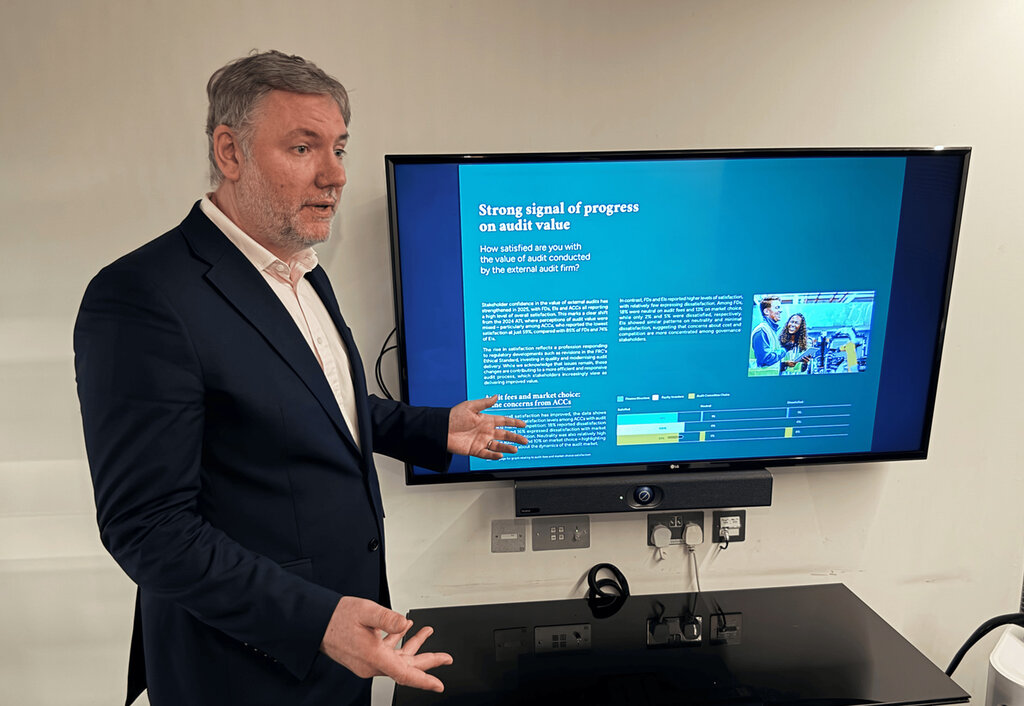
Dean Beale, executive director at CPIA, giving a talk on the 2025 Audit Trust Index.
ZM: How do you define this new category against the traditional ERP model, and why would a CFO need one?
AC: If you go back 10 or 20 years, the decision facing a CFO or technology leader was relatively straightforward. The expectation was that one ERP could support both operational and financial requirements.
It was broadly accepted that finance would operate periodically, that processes would align around the month-end close and that decisions would often be based on retrospective financial information. Systems were built around the process of closing the books and keeping a ledger.
The world has moved on. There is much less tolerance today for technology implementations that take five or ten years. Organisations are, correctly, questioning the cost, duration and success rates associated with major transformation programmes. At the same time, businesses are operating in a far faster paced, high-volume, competitive environment. If the front office wants to launch a new product quickly or enter a new market, finance and the back office cannot become the reason it takes months or years to do so.
AI has compounded all of that. Organisations now recognise that many traditional ERP platforms were built for a different era. It has created the space for AI-native Finance ERP: a financial intelligence architecture capable of supporting real-time processing, trusted finance data and the level of speed organisations increasingly require.
ZM: What are the main problems you see organisations currently trying to solve through this new approach to finance technology?
AC: There are three themes that come up repeatedly in the conversations we're having.
The first is real-time financial information. Organisations increasingly want to understand what is happening across their business now, rather than waiting until the end of the month. Being able to produce something approaching a real-time P&L is becoming increasingly important.
The second is speed to market. Depending on the sector, that might mean launching new products, responding to changing customer demand or entering a new market. Finance infrastructure cannot be allowed to slow the organisation down.
The third is cost and simplification. It’s not unusual for a large bank to be running dozens of separate subledgers. We’ve seen upwards of 60 in a single institution. The opportunity is to consolidate that complexity into a single global subledger. The potential operational and financial impact of removing that amount of duplicated infrastructure is enormous.
Finance ERP isn't simply a technology story. It ultimately comes back to some very fundamental business outcomes: better information, faster decision-making, greater agility and lower cost.
ZM: You drew a link between building Fynapse as an answer to the AI-readiness problem, and the compliance issues that Aptitude used to solve with previous products. What’s the history there?
AC: For the past 10 to 15 years, much of Aptitude's work has focused on providing the solution to complex accounting and regulatory requirements, including IFRS 15, IFRS 16, IFRS 17 and their US equivalents, giving us deep access to the CFO office.
Those relationships showed us that CFOs were under growing pressure: they still had to meet complex standards but were also expected to provide information that supports growth, decision-making and risk management.
I think AI and Finance ERP represent the next iteration of that journey. Just as IFRS 15, subledgers and the move away from monolithic ERP exposed needs that existing systems weren't designed to meet, AI is creating a new set of demands on finance technology.
Many legacy systems were already struggling to meet those demands, and AI has intensified the challenge. I expect more organisations to adopt AI-native technologies and architectures that let them understand and act on financial information in seconds or minutes, rather than months or years.
That can transform finance from reporting what happened last month into helping shape what the organisation does next.
ZM: You joined Aptitude straight out of university and rose to become the CEO. How did that journey unfold, and what have been the defining experiences along the way?
AC: A defining moment arrived in 2010, when the business decided to open our first North American office. I was tipped to oversee building our US operation from scratch. I moved to Boston with one suitcase, a pad of paper and a pen, and hit the phones.
That experience shaped a lot of how I think about business today. North America wasn't simply about opening a sales office; it taught us how to operate at pace, back our judgement and get ahead of markets rather than wait for them to develop.
North America ultimately proved our way of operating worked. We showed we could serve some of the world's largest and most complex organisations while also addressing our mid-market through faster sales cycles and lighter implementations.
That's breadth of customer, rather than trying to be everything to everyone. For a company of our size, focus matters. I'd rather have real depth in a market we can lead, than chase after a mediocre presence across five.
When I became CEO, a big part of my mandate was to take those lessons and apply them globally. The principle I keep coming back to is staying externally focused.
Customers, prospects and partners will tell you where a market is heading, if you're prepared to listen closely enough.
ZM: It's unusual to have spent an entire career at one company, in a market where senior leaders typically move every few years. How has that impacted your decision-making process?
AC: My decision-making has never been about tenure, it has to be based on what's right for the business, backed by market input. If anything, staying has shown me just how powerful it is to be genuinely out in the market, listening, and letting that input, actually shape what we do.
I saw that first-hand building North America from scratch; I was able to shape that region, applying that principle of staying externally focused and letting customers and the market tell us where things were heading. But that was one part of the business. As CEO, I'm now doing that at the level of the whole company, not just a region, building something that can actually grow, not just perform well in pockets.
Fynapse is the clearest example of that broader shift. We reshaped the organisation around what we were hearing from customers and the market, and Fynapse properly hit the market in 2025, as a direct result of those changes. We're now seeing the results of that in the business.
ZM: Aptitude has worked extensively with the Big Four accounting and advisory firms to deliver these transformations over the years. How did you build those relationships?
AC: Starting without an established presence in North America meant partnerships were essential. The Big Four, technology partners and resellers gave us reach we simply couldn't have created alone. We proved this model worked and scaled it across Aptitude.
Being closer to the US market than we were back in London meant we could spot shifts earlier. IFRS 15, a new accounting rule introduced in 2018 is a great example of this.
We recognised what was coming, backed the opportunity early and made sure we were one of the first to market with a revenue recognition solution. The monolith ERPs simply weren’t built for the new requirements.
We saw a similar trend with the growth of the subledger market and the emerging demand for alternatives to the large, monolithic ERP platforms.
In telecoms, we focused on a market where we believed we could lead, established a very strong position and then used what we had learned to expand into other sectors.
And this is what Aptitude is good at: identifying an important shift, backing our judgement early, getting to the market faster than our competitors, then building on this approach with other sectors.
I won’t claim we’re always the first, but we don’t wait around for someone else to define the category and risk coming in third place. We refine as we learn and it keeps us agile.
My job now is to make sure Aptitude reads that shift correctly, moves with conviction and builds for what our customers and partners will need next.
ZM: What advice would you give CFOs and accountants trying to work out where AI can genuinely deliver value?
AC: You must start with the architecture and data. CFOs today need to be so much more than the traditional steward of accounting information. Historically, their responsibilities have understandably centred around areas such as compliance, audit, closing the books and producing accurate financial results.
None of that goes away. But what is changing is the expectation that the CFO should also become a co-pilot to the business. That means providing the wider organisation with accurate, up-to-date information that can support decisions across areas such as investment, marketing, forecasting, planning, revenue growth and risk. AI potentially accelerates that enormously, but only if the information underneath it is trustworthy.
So, my advice would be not to start by asking, "Where can I deploy AI?" Start by asking whether your finance architecture gives you the data needed to use AI effectively.
Is the architecture AI native? Is that information sufficiently granular? Is it governed? Can you access it in real time? Can you trust it? Does it retain its lineage from source? If the answer to any of those questions is no, that is where the work needs to begin.
The risk of not adapting is serious. In an AI-driven market, the gap between modern and outdated organisations will widen rapidly, as those with the right foundations innovate, launch products and respond to opportunities much faster.
Those that fail to adapt may fall behind quickly, and for some, business viability could be at risk.
Main image: Alex Curran, CEO, Aptitude Software.
Alex Curran is CEO of Aptitude Software. Curran was appointed by the Board in November 2023 after serving as Acting CEO. With over two decades at the company since joining its graduate scheme in 2004, Curran has played a central role in Aptitude's growth — including spearheading the launch of its North America office, where she rose to executive vice president and later CEO of the North America business, before taking the helm globally.
Main video credit: vectorfusionart/Shutterstock.com