
Talking Heads: Board Advisory
Geopolitical risk and corporate security advisory
In a Talking Heads interview, Zoya Malik met independent consultants who are senior advisors at Global Advisory Alliance (GAA), Ilkay Sarpdag, founder, Zenvest Partners, Mike Davies, CEO, Kigoda Consulting and Keith Morrow, MD, Kamolyn Ltd. to discuss their thoughts and unique approaches to advising Boards on a framework to assess and manage geopolitical risk and multi-jurisdictional corporate security.
Companies House is no longer simply the UK's company registrar. As the latest ECCTA progress report shows, it is becoming an active regulator of corporate data, with stronger powers to challenge inaccurate filings and greater expectations of the businesses it oversees.
Less than a year ago, research painted a worrying picture of readiness, with many firms still unclear on their obligations and more than half of surveyed directors admitting their organisations were not yet compliant with the incoming identity verification rules.
Since then, millions of individuals have verified their identities and linked their appointments, while thousands of inaccurate or suspicious records have been challenged or removed.
This progress is welcome, but it’s no reason for complacency. With the deadline now only months away, the gap between regulatory momentum and corporate preparedness remains a serious risk.
This risk is amplified for international groups with UK corporate interests. Coordinating governance data, identity verification and statutory filings across multiple jurisdictions introduces layers of complexity that take time to untangle. For accountants advising these clients, the challenges are both regulatory and logistical.
For accountants, identity verification is only one element of a much broader governance challenge. Compliance now requires helping clients maintain accurate governance records, meeting evolving reporting obligations, submitting statutory filings, as well as preparing for identity verification.
The months ahead present an opportunity to help clients address these issues before it’s too late. Those that have not yet acted must do so immediately, not only to avoid fines and filing disruptions, but also to ensure their governance data can withstand a more active, better-resourced, and more assertive Companies House.

Dr Jeremy Osborn, FCMA, CGMA, FCPA (Aust.), Global Head of Sustainability, Chartered Institute of Management Accountants (CIMA)
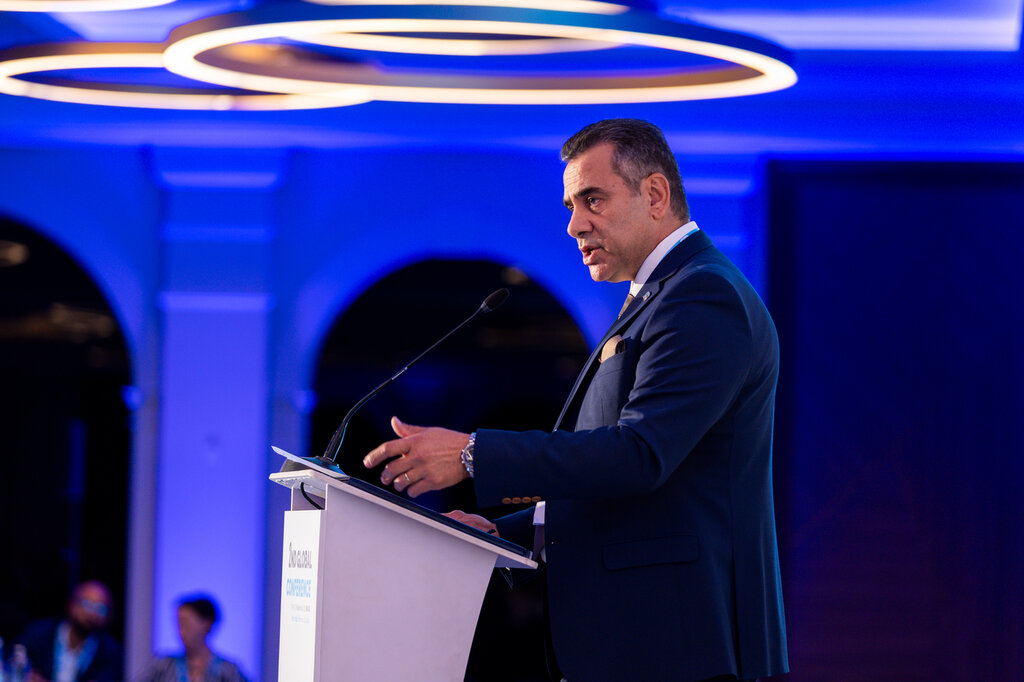
Christos Christodoulou, CEO, Delphi Alliance
"Combined global turnover is not the metric by which we measure success," states Christos Christodoulou, founder and CEO. "What matters is how effectively we collaborate to support our clients - and our growing presence on the geopolitical stage. Reaching IAB Top 20 in four years was a fantastic recognition, but even more importantly, it signals that the industry is beginning to acknowledge that the future of professional services isn't about size alone. It's about the depth and breadth of what you can deliver."
Zoya Malik: How would you advise the Board to structure its oversight of corporate security and geopolitical risk across multiple jurisdictions, particularly whether nature and severity of threats differ significantly by country?
Ilkay Sarpdag: Stewardship teams will ask which committee owns it, how often it is on the agenda, and whether the annual report’s principal risk disclosures match what management says in meetings. Inconsistency between the two is the most common trigger for a governance downgrade. In our view:
- Assign ownership at full Board level, with the risk committee holding the detailed review and reporting up each quarter. Investors read a security topic buried in an operating committee as a sign the Board does not consider it strategic.
- Yes, threats differ materially by country, and the Board should say so. Sanctions and export control exposure sit in one set of jurisdictions, expropriation and capital control risk in another, personnel and physical security in a third, cyber and data localisation across all of them. A single global heat map hides more than it shows; a jurisdiction-by-jurisdiction map with a rating per threat type can be part of the update to investors, at least in summary, in the principal risks section in the annual report.
- Name a senior accountable executive (often the general counsel or chief risk officer, with the chief security officer reporting through them) and give the Board direct access to that person, at least twice a year without the CEO in the room.
Ilkay Sarpdag, founder, Zenvest Partners
ZM: What framework would you recommend for the Board to identify, assess and prioritise geopolitical and security risks across jurisdictions, assets, people, supply chains and operations?
Mike Davies: In general, the most useful frameworks are those that aid Board decision-making, rather than those that catalogue every geopolitical and security risk across every jurisdiction, asset, person and supply chain node. This means that the framework should be linked to the decisions the Board has to make whether market entry and exit, capital allocation or resource requirements. It also means that the framework should be anchored to the Board's existing risk appetite statement, rather than building a parallel geopolitical risk taxonomy alongside it.
The framework should be built on four inputs. These are:
an exposure map, which provides an inventory across jurisdictions, assets, people, supply chain nodes, joint ventures;
A threat and vulnerability assessment, which considers the likelihood and speed that different threat types (eg sanctions and export control, expropriation and capital control, personnel and physical security, cyber and data localisation, regulatory interventions) may materialise;
An impact and materiality score for different factors such as financial, operational, legal and reputational; and
Prioritisation and appetite map which, in alignment with the Board’s risk appetite statement, reflects which risks to accept, mitigate, transfer or avoid.
ZM: How should the Board prepare for and oversee responses to government actions that could affect company, including sanctions, export controls, regulatory intervention, political instability, nationalisation, restrictions on capital or personnel and other forms of state control/coercion?
Ilkay Sarpdag: The investor question is always the same, what is the loss given event, and is it already reflected in guidance? A Board that can answer with a number, a legal position and a timeline keeps the multiple. A Board that says ‘’we are monitoring the situation’’ invites a derating and, later, a claim that risk factors were inadequate. Start by closing response gaps with the following:
- Approve a risk action playbook in advance. For each jurisdiction where business operations exist, outline what the company would do within 24 hours, 7 days and 30 days of sanctions, an export control designation, a licence revocation, a capital control or a seizure of assets. The Board should identify and approve thresholds and the sequence and not the individual decisions on the night.
- Keep the legal architecture ready and updated regularly, for example ownership structures, investment treaty protections, arbitration clauses, political risk insurance, and the ability to ring fence or exit an entity quickly in jurisdictions, where geopolitical risks are medium to high on the scale.
- Plan the disclosure alongside the response. A government action against a company can be constituted as inside information. UK MAR or a Form 8-K trigger under US rules for the company to inform the market. The playbook must state who decides on an announcement, within what time frame, how the Board is consulted.
ZM: What Board-level decision rights and escalation protocols should be established so that management can respond quickly to a developing security geopolitical event, while ensuring appropriate Board oversight?
Keith Morrow: Given that action may be required without delay following a geopolitical event, management and the Board should have clearly defined responsibilities and understand how the response will operate. For companies engaged in international trade or with foreign investment, best practice is to have a policy and procedure setting out the response to a material geopolitical event.
The Board, normally through the Chair, should be notified when management activates the response. Management should then lead the operational response, providing the Board with regular updates on material actions and seeking approval for financial or legal commitments above agreed management authority limits.
The Board should be informed of any regulatory engagement and consulted on significant external communications. Any resulting material strategic change should require Board approval, such as exiting a market, disposing of a material asset or changing the company’s risk appetite.
The policy should distinguish between decisions required to address an immediate threat and those that could materially affect strategy, risk appetite, financial position or reputation.
Finally, the policy should specify management’s authority where the Board cannot be contacted. In an extreme situation involving material risk to people, assets or business continuity, management should act immediately within defined parameters and report actions taken to the Board as soon as practicable.
Keith Morrow, MD, Kamolyn Ltd.
ZM: What independent intelligence, reporting and early-warning capabilities should the Board expect management to provide, to identify emerging geopolitical and corporate security threats before they became material events?
Mike Davies: There isn’t a single correct approach, but, in general, Boards should expect management to have either in-house or external political and security risk advisors, probably both. There should be a mix of skills and expertise depending on the sector and geographies involved – generic country-risk commentary or current event news analysis will not be sufficient to identify critical geopolitical and corporate security threats in advance. In-country sources with local language knowledge will also be important to ensure quality information flows.
These teams should provide structured threat assessments that correspond to the relevant risk rating for each country or specific asset. The assessments should include forward-looking indicators such as shifts in political rhetoric and social unrest factors and use consistent metrics so that trends over time are visible. The reporting cycle should be regular with ad hoc real-time alerts for material developments. Boards should periodically test the credibility of response by, for example, reviewing whether a material event was flagged sufficiently in advance.
Boards should also be cautious of relying solely on intelligence or reporting received from the local business unit or country management, who might downplay risks to their operations. A direct reporting channel that bypasses filtering by operational managements, is also critical for Boards to verify the accuracy of information. Similarly, a whistleblowing channel should also be established for when normal channels breakdown.
Mike Davies, CEO, Kigoda Consulting
ZM: How should the Board assure itself that crisis management, business continuity, personnel protection and evacuation arrangements are sufficiently robust and consistent across jurisdictions, while still reflecting local conditions?
Mike Davies: Assurance should focus on stress testing, rather than relying on documentation review. There should be a minimum standard for business continuity, crisis management and evacuation planning across all jurisdictions, but the specific details of evacuation routes, medical support and communication protocols, will need to reflect local conditions. Local knowledge is critical in getting this right. It can’t rely on a centrally written template, that has not been subjected to conditions on the ground.
Duty-of-care obligations also differ by country and by employment status and need to reflect local requirements. Travel tracking, medical evacuation insurance and emergency communication capability must be accessible and operational. Regular testing and audits against recognised standards will help with assurance here too.
ZM: What should the Board expect in terms of oversight of geopolitical exposure arising from suppliers, partners, agents, joint ventures and other third parties, and how should these risks influence strategic and commercial decisions?
Keith Morrow: Over the past five years, geopolitical risk has moved into the leading group of risks identified in the World Economic Forum’s Global Risks Report. As a result, geopolitical considerations have evolved from being primarily relevant to procurement and foreign compliance decisions, to becoming an important component of broader business and strategic risk management.
Geopolitical risk can create exposures across a range of areas, including supply chains, ownership structures, regulation, markets, logistics, investment and third-party relationships. With more than ten potential exposure areas to consider, this can represent a significant volume of information for a Board. To make this both digestible and actionable, the Board’s focus should be on material exposures, prioritised through the organisation’s corporate risk framework and risk matrix.
Third parties—including suppliers, partners, agents, joint ventures and other commercial relationships—can create or increase these exposures. Geopolitical risk should therefore form part of the management of significant third-party relationships and be considered when major commercial or strategic decisions are being made.
Where the Board is asked to approve a significant commercial decision involving activity in a foreign country, it should expect management to provide a clear assessment of the relevant geopolitical risks. This should allow the Board to consider geopolitical exposure alongside the commercial case, and make a more balanced and informed decision.
A current example is the impact of regional conflict on global logistics. The diversion of shipping routes around southern Africa has increased transit distances and costs for some Asia–Europe trade routes, demonstrating how geopolitical events can have a direct and material impact on margins, working capital, customer service and supply chain resilience.
ZM: In your view, what does an effective Board governance model for corporate security look like across multiple jurisdictions, and what independent assurance should the Board obtain to determine whether its current arrangements are genuinely fit for purpose?
Ilkay Sarpdag: Fit for purpose, from the investor’s side of the table, means three things. The Board can describe the model without notes. The model has been tested and the results were reported. The disclosure matches the reality a stewardship team hears in engagement. Investors judge risk oversight after the fact, by whether the Board looked prepared before it.
For further reading, do download the white paper ‘Steering Boards Through Geopolitical Turbulence’ co-authored by nine GAA practitioners: www.globaladvisoryalliance.com
Main video credit: Infi Studio/Shutterstock.com